The Risks of Investing in the Australian Property Market in 2026
6479POSTED:
0
Views

Articles by Matthew Gilligan.

I recently ran a webinar on the risks of investing in Australian property, because I've seen a few too many clients get caught out lately - buying at the top of the Australian market, then hitting tax bills they never saw coming.
A quick heads up before I go any further: I'm a New Zealand Chartered Accountant, not an Australian tax adviser, and nothing in this article is Australian tax, legal or financial advice. The figures below are drawn from published state revenue office and ATO material, current as at August 2026. Tax rules in this space move constantly - NSW's surcharge changed in January 2025, Victoria's NZ-citizen test in November 2025, Tasmania's concessions in June 2026. Verify the current rules against your own circumstances with a qualified Australian tax professional before you sign anything, and brief your New Zealand accountant on the full cross-border picture first.
This webinar was prompted by real client experiences. We've had a couple of clients get stung with tax bills and investment decisions in Australia they didn't see coming - largely because they bought at the top of the market without talking to us or an Australian tax adviser before they transacted. It's really hurt them.
The trap is assuming what applies in New Zealand applies over the Tasman. It doesn’t. We don't have stamp duty here (abolished in 1999). We don't have a general capital gains tax. We don't have land tax (abolished in 1990). Australia has all three, plus surcharges, residence tests and traps aimed squarely at foreign buyers that you may not see coming until settlement day.
There are three big differences that catch New Zealand investors out in Australia, on top of anything you'd expect at home: foreign buyer surcharges, ordinary stamp duty, and capital gains tax with no concessions for non-residents. A fourth - annual land tax - adds an ongoing bill New Zealand simply doesn't have.
Here's the part that trips people up: Commonwealth rules and state rules run different tests, and passing one doesn't mean you pass the other. Most NZ citizens buying personally are exempt from needing FIRB (Foreign Investment Review Board) approval, because they hold or are eligible for a Special Category Visa (SCV) - no application, no fee, no waiting period. But Queensland's Additional Foreign Acquirer Duty (AFAD) runs a stricter test: you only escape it by actually holding an SCV at the time of the transaction, which in practice means being physically in Australia when you sign, not merely eligible to be there. A Kiwi living in New Zealand holds no SCV at all, which is exactly why they're still "foreign" for AFAD even though FIRB waves them straight through. NSW and Victoria go further still, now requiring around six months of actual Australian residence. Note that if you buy through a company or foreign trust, none of these exemptions apply.
Take a $650,000 standalone house - the most land-rich purchase you can make, and the worst case for both land tax and AFAD if your tax planning isn't right.
A Queenslander buying the identical house pays only the $22,275 in stamp duty. A New Zealand buyer purchasing at home pays nothing at all. Here's how Queensland compares with the rest of the country:
| State / territory | Stamp duty on $650k | Foreign buyer surcharge | Offshore NZ buyer pays | % of price |
|---|---|---|---|---|
| Victoria | A$34,070 | 8% - A$52,000 | A$86,070 | 13.2% |
| New South Wales | A$23,437 | 9% - A$58,500 | A$81,937 | 12.6% |
| Tasmania | A$24,623 | 8% - A$52,000 | A$76,623 | 11.8% |
| South Australia | A$29,580 | 7% - A$45,500 | A$75,080 | 11.6% |
| Queensland | A$22,275 | 8% AFAD - A$52,000 | A$74,275 | 11.4% |
| Western Australia | A$24,890 | 7% - A$45,500 | A$70,390 | 10.8% |
| Northern Territory | A$32,175 | None | A$32,175 | 5.0% |
| ACT | A$17,880 | None - 0.75% p.a. land tax | A$17,880 | 2.8% |
| New Zealand | NZ$0 - abolished 1999 | - | NZ$0 | 0% |
Every state surcharges foreign buyers on top of standard duty. The territories run it differently: the Northern Territory charges no surcharge at all, and the ACT charges none either but taxes foreign owners 0.75% of land value annually instead - which is why it ends up cheapest overall, even without an AFAD-style charge.
The tax bill doesn't stop at settlement, either. On a 20% deposit of A$130,000, add the A$74,275 of stamp duty and AFAD - which banks won't lend against - and you need A$204,275 in cash before you own a single brick, 57% more than the deposit alone. Then there's currency risk: the NZD/AUD rate has repeatedly swung more than 10% over typical hold periods, and a 10% adverse move on a year-10 sale equity position of roughly A$450,000 is about A$45,000 either way. Non-resident lending is tougher too - fewer lenders, bigger deposits, and banks shading (discounting the value of) your NZD income when assessing what you can service.
Queensland taxes the statutory value of the land itself, every year - not the house price, and not something New Zealand has at all (we abolished land tax in 1990). Absentee owners, a definition that expressly captures NZ citizens without a permanent visa who don't usually live in Australia, lose the local $600,000 threshold altogether and are taxed from $350,000, plus a 3% surcharge.
On this $650,000 illustration, land tax starts at roughly A$4,858 in year one and, as the land value grows, climbs to about A$15,806 by year ten - a cumulative A$99,766 over the decade. A resident Queenslander with the same $650,000 rental would typically pay nil. Note this is specific to a detached house with a high land component; an apartment on the same numbers would face closer to A$9,000 over ten years, a townhouse around A$61,000.
As a foreign tax resident, there's no 50% CGT discount and no main-home exemption - the full nominal gain is taxed, at non-resident rates from the first dollar: 30% up to $135,000, then 37%, then 45%. Separately, since January 2025, 15% of the gross sale price is withheld at settlement. This isn't an extra tax - it's a cash-flow holdback credited against your final assessment (and refunded if you've overpaid) - but it's a significant chunk of cash tied up until your return is filed.
New Zealand has no general capital gains tax. Our Bright-line test only taxes a gain if you buy and sell within two years, and doesn't apply to your main home; outside that window, no tax arises under Bright-line. Other land-sale rules can still bite in specific situations - resale intention, dealer or developer status - but a genuine long-term rental generally sits outside those. Worth flagging for balance: Labour, currently in opposition, has proposed a 28% CGT on investment property from 1 July 2027 if elected. That's policy, not law, but it's a live risk to watch on our own side of the Tasman too.
Announced in the 12 May 2026 Budget and now law (effective from 1 July 2027), the package makes two changes worth knowing about:
Sound familiar? New Zealand introduced its own version of this back in 2019, ring-fencing residential rental losses so they can only offset rental income, not salary. Directly, this change means little for a NZ-based owner: foreign residents never had the CGT discount, and your NZ salary was never in the ATO's net for offsetting property losses anyway. Indirectly, it matters plenty - Australian resident investors face a higher-tax world from mid-2027, one more headwind on the market you'd be buying into.
Running matched 10-year, same-currency illustrations with identical purchase price, rent, growth and finance assumptions on both sides of the Tasman, the same $382,312 gain plays out very differently once tax is applied.
Both properties are geared the same way - an 80% LVR, interest-only loan at 5% - so both start out negatively geared, running a rental loss in the early years while rent (growing 3% a year) catches up to the fixed interest cost. The New Zealand property crosses into profit around year six; the early ring-fenced losses carry forward and offset those later profitable years, which is why only $222 of tax falls due across the whole decade. The Australian property never gets there - the annual land tax alone exceeds the rental shortfall every single year - so roughly $99,000 of losses stay trapped, quarantined under the same rules discussed above, until they're finally used to offset the gain at sale.
Add it up and the Queensland illustration carries roughly $243,000 of selected Australian and Queensland taxes over the decade, against just $222 in New Zealand on the same numbers - before you even factor in FX movement or financing drag.
Worth acknowledging: if you found a legitimate way to avoid AFAD specifically, you'd add that $74,275 back to the retained gain, taking you to roughly half the New Zealand outcome rather than a third. Tax still knocks the Australian return around either way, and it's exactly why you need advice from an Australian tax professional before you sign anything, not a rule of thumb from a webinar.
New Zealand has spent four years - 55 months - correcting: prices down 17.7% nominally, closer to 30% in real terms once inflation is stripped out. Unemployment climbed from a low of 3.2% to an 11-year high of 5.6%, the OCR peaked at 5.50% and held there for 15 straight months, and GDP per capita went through its worst run since 1991. It's been a hard slog, but we're likely closer to the end of that adjustment than the start.
Australia, by contrast, has largely been partying through New Zealand's pain. Brisbane alone is up 122% since 2020. National values only rolled over from a peak around March 2026, and July's 0.7% monthly fall was the steepest since December 2022. AMP puts Australian values roughly 20% above trend; ANZ is picking falls of 5% to 15% over the next 12 months, with the correction potentially running 12 to 24 months before it bottoms out. The affordability numbers back this up: Australia's price-to-income ratio sits at a record 8.2x against its own 20-year average of 6.8x, while New Zealand has already corrected back to 7.2x - near our own long-run average.
The Reserve Bank of Australia is sitting on a cash rate of 4.35% with an explicit bias to hike further, and because roughly 70% of Australian mortgages are on floating rates, any rise bites fast. Around 45% of median household income is now needed to service a new Australian mortgage, and mortgage stress has been climbing for five straight months. Australia does have real cushions that could soften the landing: migration planned at 225,000 to 295,000 a year against New Zealand's roughly 24,000; a compulsory superannuation pool of about $4.44 trillion providing deep, recurring domestic capital; and Brisbane's 2032 Olympics driving a $7.1 billion infrastructure programme through the region.
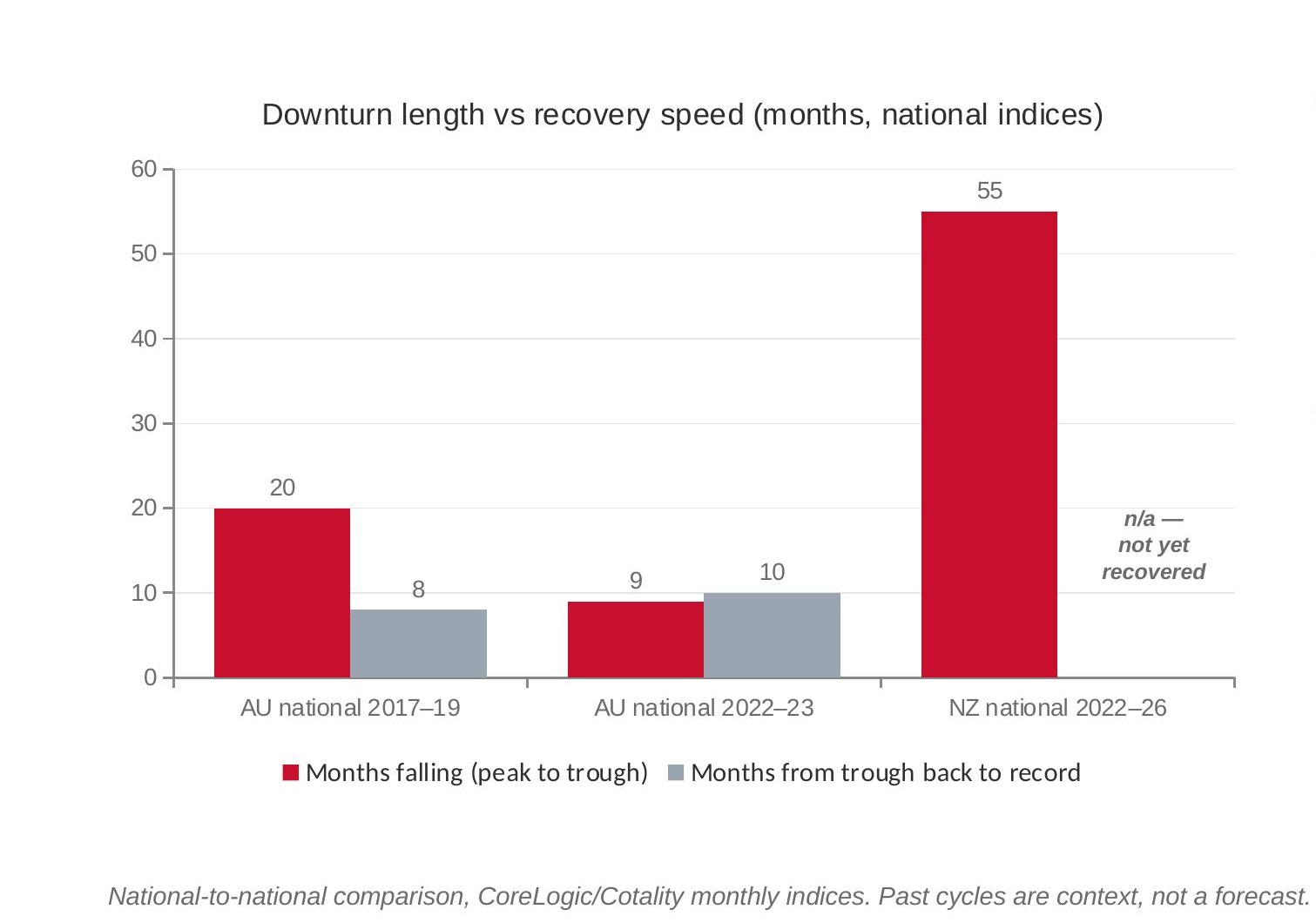
History backs up my instinct that Australia's corrections tend to be sharper but shorter than ours: the 2017-19 downturn ran 20 months down and just 8 months back to a fresh record; 2022-23 was 9 months down and 10 months back. New Zealand, 55 months on, still hasn't recovered. My own read is that theirs plays out as a V and ours has been more of a long, sideways L - a reason for optimism about Australia's medium-term recovery, but not a reason to think now is a good entry point.
I'm not saying never. If you find a genuinely good deal, there's nothing wrong with taking it. But most buyers going in today are paying record prices in a market whose correction has only just begun, while carrying a tax structure that swallows around 64% of the after-costs gain (per the matched illustration above).
Two things I'd weigh up before doing anything: the tax drag is structural and real, and it changes your return maths regardless of timing. Timing itself matters too, because Australia looks to be near the top of its cycle at the very point that New Zealand is closer to the bottom of its own. And even once the cycle turns in Australia's favour, past form suggests the window from trough to record could be short - so being ready beats being early.
If you're weighing up structuring for a purchase into Australia, GRA can help on the New Zealand side of that picture.
Get in touch to book a meeting.
This is general information only, reflecting GRA's own view of the data as at August 2026 - not tax, legal or financial advice.


Prompt, polite and friendly, competent.
- Penny Darwin, February 2024


Gilligan Rowe and Associates is a chartered accounting firm specialising in property, asset planning, legal structures, taxation and compliance.
We help new, small and medium property investors become long-term successful investors through our education programmes and property portfolio planning advice. With our deep knowledge and experience, we have assisted hundreds of clients build wealth through property investment.
Learn More









 Free Resources, Tools & Downloads