GRA Blogs

Articles by Salesh Chand.

Salesh Chand

Can you still create equity in property in a flat market?

6641

Key Takeaways

  • Equity can still be created in a flat market by buying below value and adding value, rather than waiting for prices to rise.
  • Six recent client deals created around $2.7 million of equity, from long-term holds to quick trades and a subdivision.
  • Sort out your working capital first, so you can act on a deal and hold through a downturn without being forced to sell.
  • Discounts are most often found at mortgagee sales, auctions that pass in, long-listed properties, and motivated sellers.
  • Don’t overcapitalise. Spend only what the area will pay for, and keep a contingency of at least 10%.
  • Whatever the election result on 7 November, properties you never need to sell, with strong tenant demand and room to add value, are the safest place to be.

Yes, you can still create equity in property, even in a flat market with an election around the corner. You just can’t rely on rising prices to do it for you. Over the past six months, I’ve watched clients create around $2.7 million of equity across six deals by doing three things well: getting the numbers right before they signed anything, buying at the right price, and adding value to what they bought.

In our recent webinar, The Proof Is in the Property: Creating Equity in an Election Year, Maggie Zabaglo, Than Sundar and I took viewers through those deals step by step. This article covers the key points, including what to look for when you buy, where the discounts are, which renovations pay off, and how to position your portfolio whatever the election result.

You can watch the full webinar here or at the bottom of this article.

A quick note before we start: Maggie, Than and I are not financial advisers. This is general information only, so please get advice for your own situation before making investment decisions.

What is happening in the NZ property market right now?

The market has gone flat, but there is more money sitting on the sidelines than I’ve ever seen. Experienced investors have overdraft facilities, offset accounts and cash ready to go, and they are all looking for deals. Traders are active because funding is easy to get, and banks have relaxed their lending to investors.

At the same time, several things are holding buyers back: pre-election uncertainty, higher fuel prices from the conflict in the Middle East, and a share market that has knocked some investors’ confidence. I’ve had clients tell me they wish they’d left their money in property or in the bank.

That combination makes it a buyer’s market in many areas. We’re seeing plenty of supply in:

  • Auckland terraced houses, especially those without car parks, which are harder to sell and harder to rent
  • New builds and sections in growth areas, where developers carrying funding costs need to sell
  • Older homes needing work, as long-term owners downsize
  • Lifestyle blocks, as rates, insurance, upkeep and travel costs push retirees to move

For long-term investors, it’s a good time to buy. Tenant demand stays strong for good properties, and in New Zealand a good property usually means one with a car park, ideally two.

Why does working capital matter for property investors?

Working capital is the cash or credit you can draw on at any time. Without it, even a family with millions in assets can feel under pressure every week.

In the webinar, I showed an example family with a $2 million home, a $1.5 million business, a $900,000 bach and $1 million of investment property. They had only $50,000 of working capital. With the same assets, but $540,000 available through overdrafts, offset facilities and credit cards, the money pressure disappears.

Most people say, “But I’ll never use it.” That’s the point. If the business needs $200,000 for a few months, or the market turns, you don’t have to beg anyone for money or fire-sell an asset.

It took me nearly four years to set this up across my own portfolio, and it’s the reason I can now act quickly when a deal comes up. I covered more on managing cash flow in a tough market in my Surviving and Growing in a Slow Economy blog, which you can read here (it also has a link to the webinar on the same topic).

How much equity can you create in property?

These six deals were all done by GRA clients within the past six months, and they’ve given us permission to share them. Three are long-term holds and three were sold.
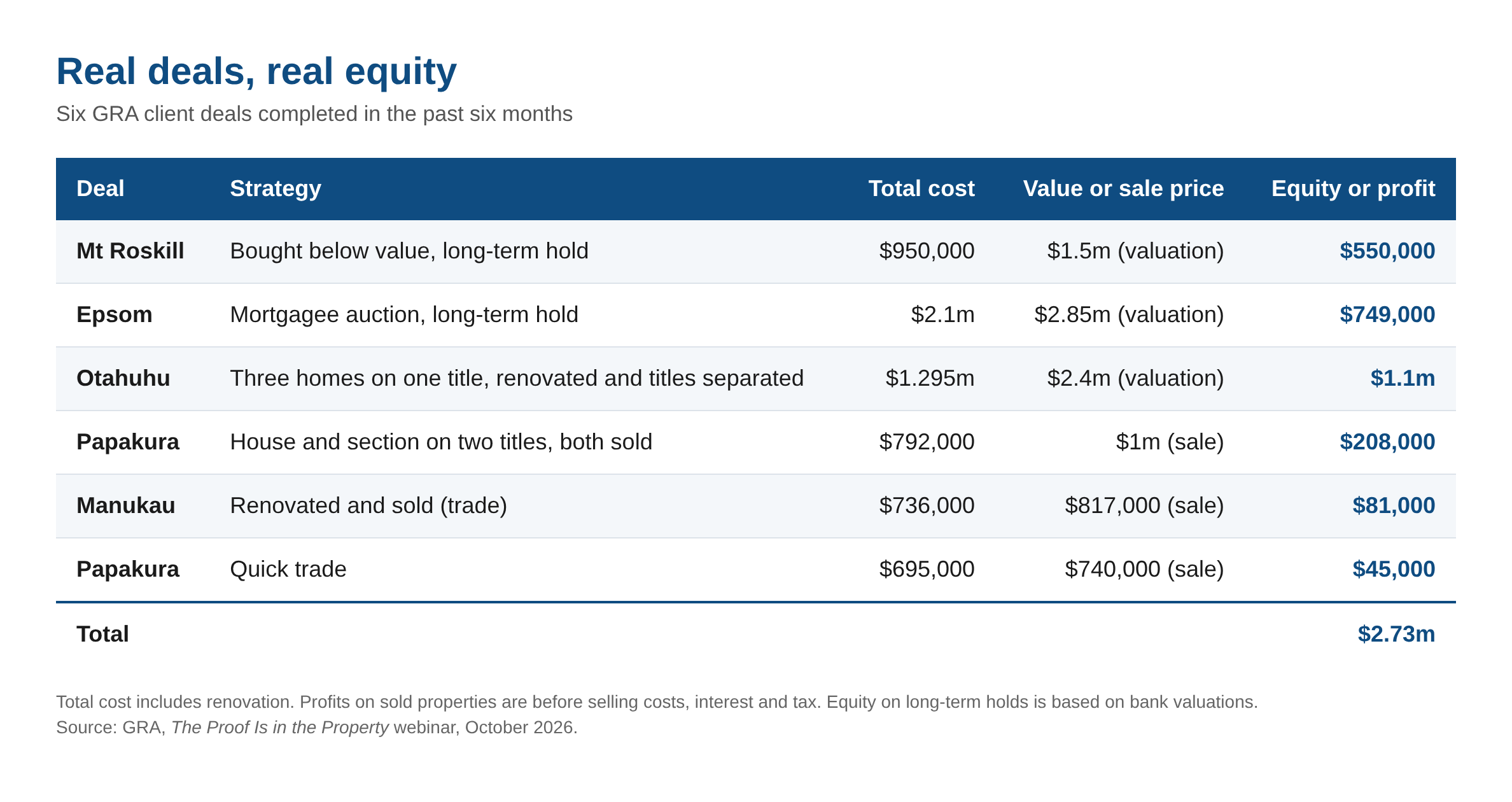
Table of six GRA client property deals in Auckland that created $2.73 million of equity through below-value buys, renovation and subdivision
Figure 1: Six GRA client deals from the past six months. Profits on sold properties are before selling costs, interest and tax.

The Otahuhu deal is a good example of what’s possible. The client bought three homes on one title at auction for $1.085 million and spent around $210,000 on renovation and separating the titles. After about eight weeks of work, it was valued at $2.4 million. He’s keeping all three and renting them to a social housing provider.

The Mt Roskill client also has room for three more dwellings on the site. Because the bank valuation has created equity, he can refinance to fund them over time, without putting in more of his own cash.

How do you choose a good investment property in a flat market?

Buying well comes down to two things: location and property type. Get these right and you set yourself up for strong tenant demand and long-term growth.

Location:

  • Look for areas with strong employment and higher incomes, because tenants follow jobs.
  • Good transport, schools, medical services, shops, parks and other amenities all matter.
  • Established or up-and-coming areas both work, but avoid rough areas and natural hazards.
  • With recent floods and landslides, check flood zones and land stability carefully, and always confirm you can get insurance before going unconditional. If you can’t insure the property, the bank won’t release your funds. Our insurance partner Initio can give you a quick quote, and our basic property due diligence checklist is a good place to start.

Property type:

  • Look for something low maintenance, durable and well built, with good design, weathertightness and ventilation.
  • Warm, dry, sunny properties with parking are always in demand.
  • Ideally, buy where the vendor has already paid for upgrades and big repairs, and where there’s space to add a second dwelling.
  • Avoid oversupplied property types and poorly designed layouts, as they’ll struggle on both value and rent growth. We covered the properties we’d walk away from in Don’t Buy That! Properties We Would Not Touch.

How can you buy property below market value?

Buying at a discount gives you equity on day one. As the saying goes, you make your money when you buy. Here’s a simple example from a client Maggie helped:

  • Purchase price: $600,000, with a $180,000 deposit and a $420,000 bank loan
  • Market value: $700,000
  • Equity: $280,000, which is $100,000 more than the deposit they put in

The client can refinance and use that equity towards the next property, rather than saving another deposit. My first deal in 2010 created $40,000 of equity, and it felt like winning Lotto because it let me buy my second property.

The places we’re seeing discounts right now are:

  • Mortgagee sales. You often can’t inspect the property, so expect missing items and factor in the risk. Don’t overpay.
  • Auctions that pass in. The vendor’s confidence drops, so a quick unconditional offer can secure a good discount.
  • “Urgent sale” or “must sell” listings. Vendors may have lost a job, be moving overseas or be selling an estate.
  • Properties unsold for a long time. If it’s still listed, the vendor wants to sell, and the agent is motivated too.
  • Vendor price reductions. These sellers are usually motivated, and the price may drop again.
  • Properties needing work or unfinished projects. Many first home buyers won’t touch them, which gives you room to negotiate.
  • Unconditional offers with quick settlement. These are attractive to vendors, but only make one once your due diligence is done.
  • Buying directly from family, friends and neighbours. Everyone saves on agent fees and it can be a quick, simple deal.

Whatever the situation, ask the agent why the vendor is selling. It tells you how much room there is to negotiate.

Which renovations add value to an investment property?

The renovations that add value are usually the cheaper, cosmetic ones that make a good first impression. As Than pointed out, buyers judge a property from the street, so don’t leave the outside until last.

Work that adds value:

  • Cleaning, painting and tidying the grounds
  • Water blasting the house, fences and driveway
  • Simple updates to fixtures and fittings, such as the letterbox and light fittings
  • Kitchens and bathrooms, kept on budget and in neutral colours
  • Staging the property if you’re selling, so an empty house looks like a home

Work that can just cost money:

  • Hidden repairs such as wiring, plumbing and foundations
  • Insulation, double glazing and a new roof
  • New hot water or solar systems
  • New fences, garages and driveways
  • Recladding

These can add value, but often less than they cost. If a property needs this kind of work, you need to buy at a price low enough to cover it.

Than and I learned this the hard way on a project in New Lynn. We replaced the windows with double glazing and turned the house into a Taj Mahal, spending about $170,000. The market would only pay $820,000, and we made just $10,000 to $15,000 after months of work. We could have spent $60,000 and made the same or more. Nobody walked in and looked at the windows.

Every area has a price ceiling. On a $700,000 house, a $20,000 kitchen won’t get you $720,000. The same goes for rentals: tenants won’t pay $50 more a week because you replaced carpet they never complained about.

Should you add a granny flat or subdivide?

If you’re building a long-term portfolio, a big empty lawn isn’t earning you any rent. Adding a dwelling can lift your yield and create equity from land you already own.

One minor dwelling (granny flat) of up to 70 square metres can now be added to most sites without a building consent or resource consent, as long as it’s properly designed, built by licensed professionals, and notified to council. If you want to go further, many zones, especially in Auckland, also allow several dwellings on one site without subdividing, although these need the usual consents. Check the rules for your property with council first.

As Maggie explained, whether to subdivide depends on your goals:

  • Subdivide if the numbers work or you want to sell off part of the site. Separate titles are usually worth more, but costs and rates are higher.
  • Don’t subdivide if you’re holding for rental income. You avoid the extra costs and can still add dwellings.
  • Keep, reconfigure or reposition existing dwellings where you can. Removing a house throws away value, and replacing it can cost $200,000 just to get the same rent back.

Whatever you do, cost it fully, check zoning, contributions and services, and make sure you can fund it and hold it. If you’re thinking about a bigger project, our Property Development School and free e-book on property development and tax are good places to start.

How do you know if a property deal stacks up?

The basic equation is simple: value on completion minus total cost equals equity created. On the Otahuhu deal, that was $2.4 million minus $1.295 million, which is $1.105 million of equity.

Where people go wrong is underestimating the total cost. Make sure yours includes:

  • Purchase price and purchase costs (or current value if you already own it)
  • Design, consultants, consents, and build or renovation costs
  • Development contributions and service connections, which can be very expensive
  • Finance fees, interest and possible refinancing costs
  • Legal, accounting, valuation, quantity surveyor and other advisers’ fees
  • Rates, insurance and vacancy (lost rent)
  • Selling or letting costs
  • A contingency of at least 10% (you will use it)

Interest is the thing people tend to forget. If a project runs over and your loan moves to a default rate, your equity can disappear quickly. Have a refinancing plan in place in case things take longer than expected (see Should You Fix, Refinance or Wait?). Most of all, keep emotion out of it. If the project costs as much as the finished property is worth, you won’t be able to refinance.

What mistakes should property investors avoid?

We’ve learned some lessons the hard way. We’ve gone over our 10% contingency on almost every project we’ve finished. Delays and red tape from service providers are usually the cause. More recently it has also been because of the problems in the Middle East affecting oil prices, and the cost of materials increasing, both beyond our control.

On one project, sorting out a power line with the network company took nearly three years, cost us around $480,000, and nothing about the power line actually changed.

Our main lessons are:

  • Don’t do more than you need to.
  • Allow for values falling in a falling market, and have working capital so you can hold.
  • Do thorough due diligence before going unconditional, including insurance.
  • Use generous contingency sums.
  • Don’t overpay for a property that needs major work, and don’t get caught up in bidding wars at auction.
  • Work fast to cut holding costs.
  • Use quality consultants and trades.

How could the 2026 NZ election affect property investors?

The main parties have now set out their positions on property tax, and both outcomes leave room to keep investing. Here’s a summary of what has been announced.

If Labour leads the next government:

  • Labour has said it will make no changes to interest deductibility for residential landlords.
  • It proposes a 28% capital gains tax on residential and commercial investment property, with the family home excluded. It would start on 1 July 2027, and for existing properties only gains after that date would be taxed. GRA partner Matthew Gilligan explains why he thinks the policy is flawed in his blog, Labour’s Capital Gains Tax Policy: Well-Intentioned, Deeply Flawed.
  • Under this policy, holding long term without needing to sell becomes more valuable. Choose properties you’d be happy to own indefinitely, and review your current portfolio on that basis.

If the current government is re-elected:

  • Interest deductibility stays.
  • ACT has proposed removing loss ring-fencing, which would let rental losses be offset against other income.
  • Under this policy, value-add projects and rental developments with early losses become more attractive.

In my opinion, every property investor should be voting for ACT. I really like the ring-fencing policy, and not because it keeps accountants busy. It lets young people get into property investing. Tax incentives are what got me started, and we need to give young people a reason to stay in New Zealand rather than heading to Australia for the tax advantages.

These are party proposals, not law, and the details may change after the election. Whatever happens, don’t let politicians drive your investment decisions. If you’d like to know how either outcome could affect your own position, our property tax structures team can help.

How should you position your property portfolio after the election?

The good news is that the same approach works under either outcome:

  • Buy so you never need to sell. This avoids forced sales and any future capital gains tax. I still own properties I bought 15 to 20 years ago, and I’ll never sell them.
  • Choose properties you can add to. You can grow your portfolio without buying more land.
  • Focus on cash flow. Let the rent pay down your debt.
  • Buy for long-term tenant demand. Choose locations and property types that will always rent, such as homes close to schools.
  • Create future passive income. Good buying decisions now will pay off later. In my experience, around 10 good rental properties is enough to give you a comfortable passive income once expenses and tax are covered. I explain how in From First Purchase to Financial Freedom.

My advice hasn’t changed in 10 years. Don’t do nothing, and don’t use lack of time or fear as an excuse. Set yourself a timeline with targets, surround yourself with the right people, and think long term.

Ready to find your next deal?

If you’d like help reviewing a deal, setting up working capital, protecting your assets or positioning your portfolio for after the election, our team can talk it through with you. The initial meeting is free for new clients. Request a meeting, or call 09 522 7955 and ask for Aimee.

To learn the full process, from buying well to growing your portfolio, take a look at GRA Property School, our online, on-demand course.

Watch the full webinar below

Maggie, Than and I go through every one of the deals in more detail in the full webinar, along with questions from viewers.


FAQ

How do you create equity in property in NZ?

You create equity by increasing the gap between what a property is worth and what you owe on it. In a flat market, the main ways are buying below market value, renovating to add value, and adding a dwelling or subdividing. Once a bank valuation confirms the higher value, you may be able to refinance and use that equity towards your next purchase.

Is it a good time to buy an investment property in NZ in 2026?

For long-term investors, a flat market can be a good time to buy. There is plenty of supply in many areas, motivated sellers are more willing to negotiate, and tenant demand for good properties remains strong. Focus on location, property type and the numbers rather than trying to time the market.

How do I buy a house below market value?

Look at mortgagee sales, auctions that pass in, “must sell” listings, properties that have been listed for a long time, vendors who have cut their price, and properties needing work. Find out why the vendor is selling, and make sure your due diligence is done before you make an unconditional offer.

Do I need a building consent for a granny flat in NZ?

Since 15 January 2026, small standalone dwellings of up to 70 square metres can be built without a building consent, provided they meet the Building Code, are built by licensed professionals and are notified to council. You may still need resource consent and to pay development contributions, so check with your council first.

Which renovations add the most value to a house?

Cosmetic work usually gives the best return: cleaning, painting, tidying the grounds, simple fixture updates, and kitchens and bathrooms kept on budget. Structural work, such as recladding, rewiring or a new roof, often costs more than the value it adds.

Will Labour’s capital gains tax affect property investors?

Labour has proposed a 28% capital gains tax on residential and commercial investment property, excluding the family home, starting 1 July 2027. For existing properties, only gains after that date would be taxed, and the tax is paid only when you sell. If it becomes law, holding properties long term without selling becomes more attractive.

What is rental loss ring-fencing?

Ring-fencing stops investors from offsetting losses on residential rental properties against other income, such as salary or business income. The losses can only be used against future taxable rental income. ACT has proposed removing ring-fencing, which would allow rental losses to be offset against other income again.
Salesh Chand
signed
Salesh Chand
Partner and Director of Business Services
© Gilligan Rowe & Associates LP

Did you like this article? Subscribe to our newsletter to receive tips, updates and useful information to help you protect your assets and grow your net worth. We're expert accountants providing expert advice to clients in NZ and around the world.

Disclaimer: This article is intended to provide only a summary of the issues associated with the topics covered. It does not purport to be comprehensive nor to provide specific advice. No person should act in reliance on any statement contained within this article without first obtaining specific professional advice. If you require any further information or advice on any matter covered within this article, please contact the author.
Comments

Add a Comment

Log in or sign up to post a comment

Testimonials
My wife and I attended the Leaders event. It was a good day and a really good range of topics were included. Thank you for putting it on. - Graham C, May 2018

logo

Seminars and workshops for property investors, business owners and anyone seeking to create and protect their wealth.

View all our upcoming events
Learn More

GRA logo

Gilligan Rowe and Associates is a chartered accounting firm specialising in property, asset planning, legal structures, taxation and compliance.

We help new, small and medium property investors become long-term successful investors through our education programmes and property portfolio planning advice. With our deep knowledge and experience, we have assisted hundreds of clients build wealth through property investment.

Learn More


GRA Senior Partners
TOP