Articles by Matthew Gilligan.

TAGS:
When the 2022 income year commences on April 1 2021, the government’s new highest personal marginal tax rate of 39% will be in effect. This rate of income tax applies to individuals on income that they earn in excess of $180,000. It is likely that the implementation of this new tax bracket will lead to a flurry of taxpayers seeking advice around their structure. But before you jump into restructuring, it always pays to “look before you leap”.
The reason why there may well be a flurry of restructuring is because the government have decided not to increase the trust rate to match the new highest personal tax rate. This was a surprise to many, due to the incentive it then provides for redirecting income into trusts. However, the government are conscious of this and have given the IRD a new set of tools to monitor taxpayer behaviour. When you next file an income tax return for a trust you are going to have to disclose matters such as:
Doubtless the IRD will be trawling through this data looking for evidence of taxpayers restructuring their affairs driven by the new highest tax rate. That is not to say that all restructuring which sees income-producing assets transferred into trust ownership are going to fall foul of the IRD. In my experience there are usually other factors that drive clients to restructure to transfer assets into trust ownership.
For example, those who are self-employed, or engaged in activities that require them to personally guarantee large amounts of borrowing, want asset protection. I often find that parents want to ensure that the asset base they build up during their lifetimes is protected from exposure to relationship property claims by ex-spouses of their children. I also often come across single clients or those in newly formed relationships who want to put in place structures that allow them to preserve their independence by separating out separate assets, while simultaneously having a structure that allows them to move forward together. All of these things could drive a restructure which sees assets moved into trust protection. In my opinion, when this happens any tax benefit that may arise in the long term is not the driver and therefore the arrangements should not be viewed as tax avoidance.
You also need to be careful when moving assets around that the movement itself does not trigger an adverse tax outcome. Moving shares in companies can see imputation credits and tax losses forfeited. Moving property around can generate taxable gains on internal transfers or reset the bright-line clock – increasing the chances of there being a taxable gain at a later point in time.
Finally, there is the new trust law to take into account. While many commentators seem to be of the view that trusts are out of vogue due to these changes, I see that as being short-sighted. That said, you do need to be aware of the obligations that arise under this new legislative framework before proceeding to restructure your affairs in a manner which sees you moving assets into trust ownership.
In summary, there may well be temptation to restructure your affairs to move assets held personally into trust ownership, particularly in light of the new highest personal marginal tax rate. However, care needs to be taken when restructuring as there are many potential unintended consequences. At the same time, a carefully conceived and executed restructure can provide you with long-term asset protection, estate planning and tax benefits. As always, seek expert advice. Please get in touch if you'd like to talk to us about restructuring - we would be very pleased to assist you.

Property School worked for me & further advice as a client gave me confidence to advance subdivision. Thanks. - Mike, June 2018

Gilligan Rowe and Associates is a chartered accounting firm specialising in property, asset planning, legal structures, taxation and compliance.
We help new, small and medium property investors become long-term successful investors through our education programmes and property portfolio planning advice. With our deep knowledge and experience, we have assisted hundreds of clients build wealth through property investment.
Learn More


Meet with one of our senior property consultants to discuss your long-term plans for property investment and formulate a strategy for achieving them.
We offer both online and in-classroom education to help you move forward with your property investing.
Wealth Suite is a powerful online learning, analysis, planning and forecasting resource. There are four key components, and you can choose to use one, some or all of them.
• Cash flow analysis for home, property and business • Overview of total equity, debt and market value of assets • Analysis of home expenses and income
• Set retirement goals. • Analyse when you will be able to retire based on your current path. • Input 'what if' scenarios and see how they impact when you will reach your goals (e.g. what if I buy two investment properties in the next five years?)
Property analysis calculators for current and future investments, including: • Trade (flip) • Buy-to-hold• Subdivision• Land banking• Houses of multiple occupancy (HMOs).• Due diligence tool
Videos, articles and quizzes related to
property taxation, and asset protection
to further your education
If you are new to Gilligan Rowe & Associates, we can offer you a free initial meeting with a senior consultant to review your current structure and discuss your accounting needs. In this meeting we will discuss ways to optimise tax and protect your assets so you are in the best position going forward.
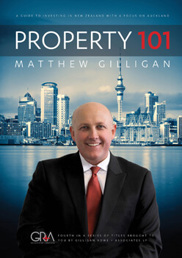
Written by GRA managing director Matthew Gilligan, we offer two books:
If you want to know how to invest in residential property in a way that maximises your chances of success and minimises risk, this is the right book for you.
Matthew Gilligan provides a fresh look at residential property investment from an experienced investor’s vi..... More
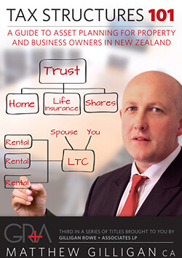
Interested in paying less tax, property investment structures, trusts and protecting your assets? This is the right book to read.
Try asking two lawyers and two accountants "How should I own my property and business assets?" You will likely get four different ans..... More
Insurance is a necessary part of mitigating risk – both for your properties and for yourself personally. GRA recommend these insurance providers. Contact them to find out more and to get no-obligation quotes.
Learn more and get an instant quote
For a free risk assessment visit www.riskdirect.co.nz

With Salesh Chand December 2025
With Salesh Chand & Kris Pedersen
With Salesh Chand - Oct 2025
With Salesh Chand - July 2025
With Salesh Chand, June 2025
with Matthew Gilligan and Tony Alexander
How to use residential property to help provide for retirement
With Matthew Gilligan and Steve Goodey, March 2025
Webinar with Matthew Gilligan and Kirsty Merriman. Nov 2024
With Matthew Gilligan and Steve Goodey August 2024
Market insights with Matthew Gilligan, Kris Pedersen, Anthony Lipscombe, and Tony Alexander - June 2024
Blandon Leung of MortgageHQ interviews Matthew Gilligan, May 2024
Webinar with Matthew Gilligan and Steve Goodey, February 2024
Ryan Melton of NZ Business Owners Podcast interviews Matthew Gilligan
Blandon Leung of MortgageHQ interviews Matthew Gilligan, November 2023
Matthew Gilligan interviews National’s Paul Goldsmith and Chris Bishop about National’s proposed policies, September 2023
Matthew Gilligan interviews David Seymour about Act’s proposed policies, September 2023
Matthew Gilligan and Kris Pedersen discuss finance for property investors, August 2023
Matthew Gilligan and Anthony Lipscombe discuss tax changes and policies, August 2023
Simon O’Connor interview. Planning rules and Labour’s proposal to scrap RMA, August 2023
Preparing for the end of the financial year, March 2023
Tax Changes & Property Market Update 27 Oct 2021 Webinar
Matthew interviews David Seymour, April 7 2021
Impact of Bright-line & Interest Deductibility Changes, March 2021
Webinar with John Rowe August 2020
The importance of good property education
Discover how to start and succeed in property investing
Arrange to meet in-person or online to discuss your affairs
With respect to the various resources available from our website, neither Gilligan Rowe & Associates LP (“GRA”), nor its owners nor any of its employees, make any warranty, express or implied, including warranties of merchantability and fitness for a particular purpose, or assume any legal liability or responsibility for the accuracy, completeness, or usefulness of any information, product, or process. GRA will not be liable for any problems or damages of any kind experienced by users of GRA’s online materials, resources or tools. The information and resources from or through this site are provided “as is,” “as available,” and all warranties express or implied, are disclaimed. The information or tools may contain errors, problems or other limitations. Our sole and entire maximum liability for inaccurate information, for any reason, and the user's sole and exclusive remedy shall be limited to the amount paid for the information, tool or other resource (if any). GRA are not liable for any indirect, special, incidental or consequential damages whatsoever.